Thursday, 26 January 2023

 Black Duck – Barr Loch, near Lochwinnoch, Clyde, 3rd December 1989

A decidedly unanimated Black Duck on ice, animated!!

A black duck! A distant male Black Duck, but despite the poor visibility it was distinct from the accompanying female Mallard.

It had been a twitch to break a grown man; Paul and I had driven north on the M6 and M74 through the dark and the fog before travelling through and beyond Glasgow and then south-west to Lochwinnoch on the M8 and A737.

Barr Loch and the surrounding area involved really good countryside, or it would have done if we could see it!

We were provided with good directions on site, and better, the bird, along with a small group of Mallard, was staked out as to rested out on the frozen loch, looking mightily upset with life in Scotland.

Was really a dark-coloured Mallard, but was distinctive in this, its grey-white under-wing (which it did obligingly show off), paler face and yellowish bill.

Almost as exciting was my second in the Scillies in October 1994. This was similarly inanimate, but involved better viewing, although the bird was not particularly co-operative; it flew from the rock upon which it had been perched near the edge of the Great Pool whilst I was erecting my ‘scope, and then continually up-ended on one occasion, and disappeared into the reeds on the other.
Black Duck, Great Pool, Tresco, Isles of Scilly, October 1994 (photographer unknown)

Saturday, 21 January 2023

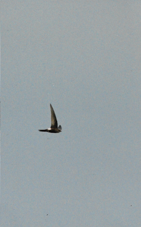
Pacific Swift – Cley Norfolk Naturalist’s Trust Reserve, Cley-next-the-Sea, Norfolk, 30th May 1993

Dashing around the skies of Cley - in amongst a large flock of congeners (sorry, couldn't resist the opportunity of using that word). Magic!!!

The weekend after my truly epic twitch for Oriental Pratincole in north Norfolk I was in St. Albans for a (quiet?) ‘weekend at home’. At this time my routine involved living and working in (or from!) South Queensferry during the week and also most weekends, and occasionally flying from Edinburgh to London Gatwick and getting a Thameslink train from Gatwick to St. Albans on a Friday for a weekend at home, before reversing the journey to be back at work on the Monday morning.

As the weekend involved was a Bank Holiday weekend I was flying south on Friday the 28th May before flying north on Wednesday the 2nd June. Perfect. A long weekend........ .

So it was (I’m sure nights at The Farriers, etc., were involved, but...) at least until the news of a Pacific Swift at Cley came through on the pager at around mid-morning on Sunday the 30th May.

I immediately relayed the news to Mike, or, in his stead, to Susie; Mike was out.

Then I panicked. At this time I didn’t have a car; I didn’t really need one, as I was rarely at home, and when in South Queensferry I had my trusty little AMEC van. So how was I going to get there? There was the option of borrowing Gary’s car, as had been discussed during a brief flurry of interest in the Bridled Tern in Northamptonshire the previous day.

But wait, there was a voicemail message from Mike on my answerphone relating to the same bird and suggesting that if I wanted to go I should ‘phone Marcus Brew and providing his ‘phone number. That was it!

I was quickly able to locate and manage to play the message (which was fortunately still there!) and take down the number. I immediately ‘phoned Marcus who suggested he was interested but others were otherwise engaged, and he would get back to me. Some while (a short while!!) he ‘phoned back, and suggested he was, "Keen to go". Ten minutes later he picked me up on the railway overbridge next to St. Albans railway station (a location he knew he could find me at!). 

It was about 11:50. We journeyed towards Norfolk buoyed by news on the pager, whilst also guilt-panged about leaving Mike behind. Susie had informed me he was out at a garden centre, and Marcus and I quickly realised that trailing around random garden centres looking for him wasn’t a sensible option when it was a swift we were twitching. This was prior to the convenience of mobile ‘phones very obviously.

Under the circumstances it was a sedate drive, with no hold-ups, although we diverted off the normal route to avoid potential delays due to an airshow at Duxford. All there way there Marcus and I were getting more and more confident as successive messages, "Pacific Swift still....." came through and I duly relayed them to Marcus. We could not believe a swift would hang around for so long. But it was doing!! As we got close we thrashed through Wiveton and Cley-next-the-Sea.

But where to park? Lots of birders were already present so cars were abandoned everywhere, but once again Marcus handled the problem of parking in a very matter of fact way. The gallery was (strangely?) spread along the high points alongside the coast road. Marcus and I briskly jogged and walked from Old Woman’s Lane towards the main point at which birders were gathered beyond the public hide. Once there we were confronted by a blizzard of swifts feeding low over the marsh, as we had noted swifts had been on our journey to Cley. But which was it? I luckily picked up on the white-rump, and commentated Marcus onto it despite the distances and extremely mobile moves of the bird involved. It was, as were the rest of the flock, feeding low over the reed-beds and water, and once it had been located it could be picked out quite easily. Having got views (and severe arm ache!) a move to near to the Irene Hide produced much better and closer views in the scudding light as showers passed through.

It had longer wings than Swift, but otherwise it appeared to be generally similar. It had a white horseshoe rump, and a more extensive pale throat (and pale forehead) than Swift. The tail was forked – and a bit like the ‘tuning fork’ shape of Red-rumped Swallow in effect.

Wow-wee!!!!!

Once it disappeared we decided to leave, and memorably suffered a puncture within a very few miles of Cley. It was just as well it didn’t happen on the way there.

I’m sure both Marcus and I continued to feel guilty about abandoning Mike despite his reassurances we had done the right thing. All the same, I was very pleased to hear that Mike had caught up with the one at Trimley Marshes in June 2016 – all the better for being in his adopted home county of Suffolk.


Pacific Swift, 
Cley NNT Reserve, Cley-next-the-Sea, Norfolk, May 1993 (photographer unknown)

Saturday, 14 January 2023

 Rock Thrush – Portland Bill Bird Observatory, Portland, Dorset, 16th April 1988

The Rock Thrush as I eventually saw it best, distantly across a ploughed field on not the best of days, well enough to get the colours!!!

What a goodie!!!

On Saturday the 16th April I was at Portland Bill, where it just felt ‘rare’, with misty conditions and some migrants.

I and others were chatting with the Warden, Mike Rogers outside the entrance to the Bird Observatory, after he suggested he had just seen a Rock Thrush opposite in what is known as the Crown Estate Field, and we then saw it as it flew away from the edge of the Observatory garden.

It was clearly a large chat-type thrush. Unfortunately, though, we and I only had brief views in poor viewing conditions as it was misty. I watched it flying along the field edge before briefly landing and then flying away again into the mist.

It had a strong direct flight which was like that of a compromise between a Starling and a Wheatear. Owing to the viewing conditions not much colouration could be directed other than the white rear to the body.

I (and others, obviously) then spent long hours looking for it in the Easton and Weston areas both that day and during the week, which mainly involved attempting to search quarries full of mist..... . I couldn’t attempt the same the following day as I had an appointment with a Black Stork..... .

Finally, the following week, on Saturday the 23rd April, after similar searches including searches of the cliffs at Weston, I and many others got views of it as it finally gave itself up in the distant corner of a ploughed field at Weston. This time the blue head and upper back, the black primaries, secondaries and coverts, white lower back and orange under-parts and tail were much more apparent.... !

Hurrah!! This was my 278th British tick.

Incredibly, on Saturday the 6th May the following year I was birding at Portland Bill with the then Alison Bunting and as we walked over the hill from the Naval Establishment up the back of the Pulpit pub, I was on something when Alison said, "You’d better come and see this". I was annoyed – because I was ‘on something’, and she wasn’t responding and instead just kept just saying, “You’d better come and see this”, but in the end I relented. I was confronted with a fast-gathering crowd down near the Obs. Whatever, the ‘something’ was was quickly forgotten and we raced down to the Obs. Once there, I was able to enjoy my second Rock Thrush at Portland Bill within just over a year!!!

This is something of a minimalist account, as I haven’t been able to find any relevant photographs….. . Then again, maybe some of the others are overly long?😊

Sunday, 8 January 2023

 Cedar Waxwing – Nottingham, Nottinghamshire, 23rd February 1996

The Cedar Waxwing attempting to indicate how I remember it; a subtly different waxwing amongst Waxwings, on a dark winter's day.

News broke on Tuesday the 20th February 1996 of a Cedar Waxwing in Nottingham – totally unbelievable…!

And so soon after the Summer Tanager scare. Wednesday was the first day of the twitch and typically I was on my way to Belfast! Aargh! Anyway, I still made the most of the trip, despite the probable dip hanging over me. On the Thursday I ‘phoned Paul Pugh from the Pressure Reduction Station at Ballylumford on Islandmagee, Country Antrim in the afternoon. He had seen it on the Wednesday, which was enough to convince me to go for it, but having heard Paul’s advice regarding avoiding the scenes at the weekend I was convinced. Or nearly so. As I was convincing myself, and convincing myself of my strategy, the bird disappeared….. . Typical!

This made me very indecisive about my plans – making things all the more baffling for Steve Boothroyd and Stuart Webster (the two work colleagues I was with) as we left Ballylumford and Islandmagee. I caught the Seacat from Belfast at 16:30, arriving at Stranraer at 18:15. From there I drove to Creetown, stopping off at the rented accommodation we shared in Creetown and at the nearby construction base, before swopping vehicles and driving to Burnley in my car rather than the work one. Larne to Burnley in seven hours! But despite having ‘phoned mum from the office she was oblivious of my arrival….!

On Friday morning I left Burnley at 07:45, to arrive in Nottingham, following Paul’s useful directions, at c.10:15. By which time it had not been seen for two hours! Rather than waiting aimlessly on Castle Boulevard I opted to drive to the area it had disappeared to on the Wednesday to search rather than stand around. This provided a few distractions – decent bakers, shops, interested locals, etc., but no birds. Following local advice, I opted to move to the nearby Hadyn Road / Mansfield Road area, where eventually at c.12:15 I saw my first Waxwings – 160 of them. Excellent!

Waxwings in numbers – giving really instructive views – with Ray Turley as interpreter – perfect. Just a shame about the fuckwits who insisted on standing right under the rowans the birds were trying to feed in. It was really strange birding in such an urban setting. For instance, at one stage I was ushered up an alley into a plumbers’ merchants’ yard so that I was much closer to the 160 Waxwings in an ash tree where they were waiting for an opportunity to feed!

I eventually left by car to Castle Boulevard to feed myself, again. Whilst in my chosen shop I got ‘gen’ on the bird. Supposedly, it had returned with other Waxwings at 13:00 the previous day, so I opted to wait around. This was fairly numbing, despite a few chats, and produced little – a few Waxwings overhead, plus a few Redwings, etc.. At about 14:00 I cracked, and decided to go back to earlier venues in the car. As I did this there was something of a rush to where some 45 Waxwings were. It seemed it was apparently with them, but by the time I had turned around, parked and assembled my ‘scope, it and they, had moved off, but thankfully only to the nearby Castle Boulevard. Here, amongst c. 150 others, I at last got good views for an hour or so. Unfortunately, these were not in the best light, and always looking up into the trees, but good nonetheless.

As depicted in my notebook, smaller and plainer than Waxwings – strangely reminiscent of Brambling at times when perched amongst the Waxwings and viewed without optics. Whitish undertail coverts rather than chestnut, pale fringes to secondaries, no black chin, very narrow white edge around black ‘highwayman’s’ mask, and yellowish wash to flanks.

Just over three weeks later I returned Nottingham with Mark Hannay the day after we had seen the Redhead nearby. I was not looking forward to attempting to find this bird again, but as luck would have it, we saw it very well, almost as soon as we got to the nearby crossroads on Castle Boulevard.

As such, we were comparatively lucky. The bird was within the parliamentary constituency of Kenneth Clarke, and despite attempting to see it he failed, though in fairness, he was Chancellor of the Exchequer at the time (when these things actually mattered……).

Dodgy original notebook sketch of the Cedar Waxwing.

Cedar Waxwing, Nottingham, Nottinghamshire, February 1996 (photograph credited to George Reszeter).

Sunday, 1 January 2023

Black-browed Albatross – Saito outcrop, Hermaness National Nature Reserve, Hermaness, Unst, Shetland, 12th April 1993

My sketch of the Black-browed Albatross as  I watched it circling below me off the Saito outcrop, Hermaness, Unst, attempting and failing, to capture the sheer enormity of everything.......!

This involved a very frustrating and freezing vigil, but ultimately, a massively rewarding one.

I had decided it was now or never for me and Albert, and so I had planned to go to Shetland during Easter 1993 to bang in this fantastic returning bird and then have some quality birding time. That was the plan. He / she / it had returned for another lonely vigil….. .

Albert Ross (I know, I know) was a returning bird that had been associated with the gannetry at Hermaness every spring-summer since 1972. Dave McAleavy and I had tried to see him/ her / it when in Shetland in May / June 1990. Now, as I was working on the Forties Crude Export Expansion Project outside South Queensferry, Edinburgh, and the project was shutting down over Easter, I had the perfect opportunity to go.

So it was that I made my second pilgrimage to Hermaness. Having driven from Edinburgh to Aberdeen and parked up my little AMEC works van on the afternoon of Thursday the 8th April, I then took the St. Clair from Aberdeen overnight and then hired a car from Bolts once I arrived in Lerwick early on the morning of Friday the 9th April, before driving north through the island chain and then walking from the Hermaness NNR car-park to almost the very northern tip of the British Isles.

For four days. I spent three, six and nine hours perched atop a cliff overlooking Saito, the outcrop on the Hermaness cliffs favoured by Albert, hoping that one of the Gannets would somehow transmogrify into a Black-browed Albatross.

A very cold south-east wind did not make the walk between the car-park and the Neap (from which I viewed Saito) or vice versa, or the vigil any the more pleasurable.

However, the scenery and the scenes, the birds and the birders all made things that bit more pleasurable.

Although I had ‘missed’ Saito on the way in on the first day, and so after my doubts, I was fairly certain I was looking in the right place. But to no avail. I retired, and having driven to Baltasound, opted for the Ungera Guest House after two shopping attempts. This may have been a good idea, as information was forthcoming following conversations in the post office. It was from the call-box outside that I later ‘phoned Ian Spence(?) who had found the bird on Wednesday the 7th April (the first date on which it had been reported in 1993...).

I then went to the fabled (and now ill-fabled) Baltasound Hotel for a bar meal surrounded by deep-sea fishermen to the appropriate accompaniment of ‘The Boys are Back in Town’ by Thin Lizzy. All very odd...... . I seem to remember them getting very drunk before boarding their fishing boat to go out to sea. I kind of get that, in hindsight.

Anyway, more of the same followed the next day, Saturday the 10th April, after some optimism caused by another birder having seen it. Richard the Hat (for it was he) had seen it between 08:00 and 08:30. So when did I arrive? Yep, too late, I arrived at 10:00. However, buoyed at least by a sighting, I stayed until 16:00 with Richard(s) for company for much of the time.

And more of the same followed the next day, Sunday the 11th April, my next day shift, this time between 07:00 and 15:30; again for nothing, despite my early start (a day too late....). Some good birds, and some good company, and a new, more sheltered viewing location. I retired eventually to both the bed and breakfast and the hotel again with good company, and prepared for my final days vigil.

On the morning of Monday the 12th April, just to break the monotony, I chose to walk up the burn to the Saito / Neap area, and on arrival I found I had the place to myself.

Better, incredibly, the bird was immediately on show as I looked back as I walked up onto the Neap. I then watched and photographed it for the next 1.5 hours as it circled around and around Saito attempting (in a half-hearted way) to land (the gannetry had grown hugely during the 19 years since the albatross was first seen at Hermaness, and now the Gannets wouldn’t let the albatross land). WOW!!!!!! It just drifted around and around without landing throughout my stay, although I lost it in the end. But that didn’t matter by then.

It was huge, with rigid dark grey wings, a white head and body, and a grey tail. It had a yellow bill and yellow feet, and both bill and feet were large. Predictably, it had a dark patch above the eye. It was like a Fulmar x Greater Black-backed Gull hybrid on steroids.

I enjoyed the whole experience so much that, when I finally twitched the Turkestan Shrike at Bempton in the summer of 2022 I wasn’t all that fussed when I failed to connect with the nearby Black-browed Albatross. I looked for it half-heartedly, admittedly but in a strange way I almost didn’t want to see it in case it somehow detracted from my whole Hermaness experience more than 29 years earlier

Welcome to Unst!
My lonely vigil over four days of the Easter weekend in 1993. but wow, what a setting! Almost as far north as you can get in the British Isles.
The famed Saito outcrop. Can you see it?
Black-browed Albatross, Saito, Hermaness, Unst, Shetland, April 1993

Monday, 26 December 2022

 Harlequin – Wick Bay and Harbours and River Wick, Wick, Caithness, 2nd March 1991


A major score after a 500 mile journey to the north of mainland Scotland..... . We arrived in Wick at about 09:45 on the morning of Saturday the 2nd March, after driving to Inverness late into the night and ‘sleeping’ there before travelling on to our rendezvous.

A thrilling drive delivered us to the scene. We piled out – and looked down the river, and then we looked up the river – but there was no sign. We went further down to the harbour itself but there was still no sign. So, we hoped, it had to be at the lifeboat station. We drove there, taking the wrong route, but in doing so we managed to achieve a classic car tick – from the cliff-top, in amongst the crashing waves, there it was. Finally arriving at the right place, I was amazed to see a littoral ‘surf’ duck, a bird that coped supremely well with large swell and breaking waves.

As we viewed in riding the waves and diving it was hugely impressive. It was generally dark brown with a pale crescent shaped patch at the base of the bill and a whitish spot on the ear-coverts. It had blackish wing-tips. It also had a grey bill, although at times with better light it looked horn in colour.

It dived frequently in an auk-like manner, using its wings to swim to depth. Otherwise, it bobbed about in the surf.

Suddenly the bird seemed to decide to swim towards the harbour mouth in a very determined way – and then continued from the outer harbour to the inner harbour with us trailing in its wake. But then it flew – and we managed to lose it. Hunger called.

Birding Rule Number 3: If you have food then the bird will appear.

Sure enough, as Paul Pugh and Billy Aspin followed along with their fish and chips we were watching the bird back at the A9 road bridge over the River Wick. This allowed us to have immense views of a fantastic bird in a town centre location..... .

Possibly one of the most memorable aspects of the whole twitch was the car we used to get us there and back. I was working on the Shell North West Ethylene Pipeline Project at the time. The otherwise largely useless Dr Alan Ryder had asked me and the other Section Environmental Officers what he could do for us as the project moved towards construction. We argued that it was essential that we had suitable four-wheel drive vehicles. Fantastically, Alan delivered, and we were each given a brand new leased 4 x 4 Subaru Legacy. And a Shell fuel card. Mine was for me to use whilst working on Sections 4 and 5 of the pipeline, from south of Lancaster in Lancashire to Stanlow in Cheshire.

It was quite probably not for taking on 500 mile round trips to the north of Scotland.... . This said, it was a fantastic experience to drive such a good car, which was just made for such journeys on such roads. It was SO good to drive, and certainly for me, made the twitch the experience it was. And the fuel was free..... . Once back at work in Carrington the following week (or maybe the week after) I overhead someone saying, “Did you hear about some dickhead, taking his Subaru all the way to the north of Scotland?” where the card was used was identifiable. I said nothing, but neither did anyone else.

Unconnected with this I would hope, the respective Construction Managers for each section staged a coup soon afterwards as they couldn’t cope with the fact that the Environmental Officers had better vehicles than they did. It was nice whilst it lasted.... .

Somewhat in contrast, just over five years later, in April 1996 whilst I was working on the Scotland to Northern Ireland Pipeline Project, I was able to take a jaunt just some 25 miles northwards along the coast from Stranraer, to take in two female / immature Harlequins at Kennedy’s Pass, near Girvan, Ayrshire. Even closer, ‘tame’ views.

The dramatic scenes as we were searching for the Harlequin on arriving in Wick; Paul Pugh explaining to Billy Aspin and Neil Tasker(?) that it's out there somewhere. I love how the car matches the sea and sky.
An altogether more tranquil setting for seeing the Harlequin; on the River Wick in Wick town centre with Goldeneyes, Wick, Caithness, March 1991
A photograph no doubt taken by me of the Harlequin, Wick, near Girvan,  Caithness, March 1991
Harlequin, Wick, Caithness, March 1991
A Scaup I caught during  our journey back south  from Wick, as you do.  (photograph credited to Billy Aspin and inscribed  "BILL ASPIN R.B.P.L. Bird Photographic Specialist No. 103 Scaup ()
A postcard of the  bridge over the River Wick in Wick town centre, where we enjoyed our best views of the Harlequin; I must have been impressed!
My dodgy photographs of the two Harlequins at Kennedy's Pass, near Girvan, Ayrshire, April 1996 
Harlequins, Kennedy's Pass, near Girvan, Ayrshire, April 1996 (photograph credited to George Reszeter)
With apologies for replicating anything associated with the Daily Express, an article about twitching the Harlequins at  Kennedy's Pass, near Girvan, Ayrshire (Daily Express  15th April 1996)

Thursday, 8 December 2022


Ivory Gull
- South Kessock / Longman Sewage Outfall, Inverness, Highland, 20th July 1995


After the mild (!!!!) disappointment of the Pallid Harrier and the fading prospect of Norfolk and its’ Serin and Collared Pratincole and optional (and as it turned out hypothetical) Great Black-headed Gull on the way, it all suddenly began to feel like fate when the news broke of an adult Ivory Gull at Inverness. I’d already arranged for the Friday off, and I then worked my escape so well that I left Creetown very early on Thursday 19th July – so early that I arrived back in South Queensferry before Gilly arrived back after an early shift. I chivvied her into some urgency on her return, and so we departed home by 14:45, and (so) arrived at Inverness by 17:00.

Unfortunately, nothing had been seen of the Ivory Gull for two hours by this time, and nothing we could do, including working the grim foreshore around the Kessock Bridge for some two or three hours, altered this depressing situation. Thwarted, we retired to Fortrose, and Chanory Point. We opted for a bed and breakfast in that part of the Black Isle.

The following morning news of the Ivory Gulls’ return cheered me greatly before breakfast. Better still, soon afterwards the news was updated and improved, apparently, as the bird was apparently at Kilmuir, on our side of the Beauly Firth.

Following a brief and close encounter with a Red Kite (as we drove down an enclosed beech avenue lane (?) towards Kilmuir it flew laboriously up the lane, and just over the car) we dipped at Kilmuir. We were similarly successful at Longman Sewage Outfall. However, we did meet Tony Collinson who was able to fill in the details of its earlier whereabouts, and we agreed we would to go back to South Kessock, where it had apparently been earlier on, and put out any positive news straight away on the pager. However, sure enough news came through that it was back at South Kessock.

As I was the bringer (or more accurately receiver) of the good news, in scenes reminiscent of Christchurch and the Little Bustard, we headed in convoy through North Inverness, towards the South Kessock Estate. We found the car park / information point beyond the estate, and here, other birders looking out over the seaweed-covered foreshore of the firth to an islet of pebbles beyond. Amongst the pebbles was a gleaming white bird – a gull, roosting, and occasionally, preening. We piled out of the car, and watched it for ages, just as drawn, by me, and apparently also by Martin Elliott. It just stayed there, just being brilliantly white, even whilst photographers edged closer, and closer and closer. Eventually, it took off, and flew around off South Kessock and then further up the firth, before returning, all the time in the ‘scope. It had a distinctive, languid flight. A description, at least of the plumage, seems somewhat superfluous it was just all white, with dark legs and two-tone bluey-grey and yellow bill. It was most like Common Gull in terms of size and shape, although it may have been bigger and was certainly heavier in build.

After some while showing well in flight, it disappeared out of sight back towards Longman Sewage Outfall, where it was later seen with other gulls. Gilly and I watched for ages, as befits such a star bird. Brilliant – a well-deserved tick after a long dry period!

So impressed were we that subsequently I put in a bid for a painting of the Ivory Gull by Martin Elliott, just as we had seen it. The painting was on offer on a closed bid basis as part of a competition in Birdwatch magazine. On our return from our Israel-Jordan-Egypt trip we found that we had been successful, and so now it hangs on my wall, in fitting tribute to the bird and a very enjoyable Highland weekend.

Subsequently, I saw a first-winter bird with Graham Clark and a young Ellen on a very cold day around New Year in 2002.


Ivory Gull, South Kessock / Longman Sewage Outfall, Inverness, Highland, July 1995 (photograph credited to Tony Collinson).

The painting of the same Ivory Gull by Martin Elliot that I subsequently won.


Ivory Gull, Montrose Basin, Angus and Dundee, around New Year 2002, complete with a very young Ellen in the car.