Sunday, 25 May 2025

 Baikal Teal – Crossens Outer Marsh, Southport, Merseyside, 4th December 2013

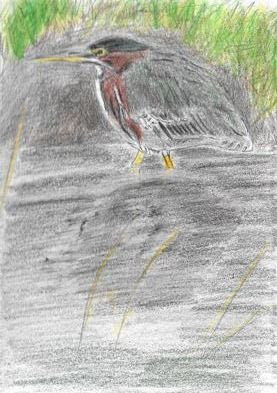
Sketches of the Baikal Teal at Crossens Outer Marsh, attempting to capture the wacky head pattern (strangely reminiscent of Red-breasted Goose and even summer-plumage Wilson's Phalarope).

Another twitch! And, more to the point, a successful one. (By way of context, for a whole host of reasons, by the 2000s and 2010s – if not a few years before – my twitching activities had slowed, and typically I was only seeing two or three new species each year. However, there were brief flurries involving more such activities; in both 2004 and 2005 I had upped the number of new species to a heady five, and during the last few months of 2013 I twitched the Mourning Dove on Rhum a month or so before this twitch, and the Brunnich’s Guillemot in Portland Harbour less than a month after it).

Anyway. Where were we? Although busy with work (I was in my ‘providing ecological and ornithological support to single wind turbine applications’ phase!) I had a few days my father’s in Chesterfield at the end of November / start of December 2013.

During the course of this, on Saturday the 30th November, an adult male Baikal Teal was found at Marshside RSPB Reserve, near Southport in Merseyside (or Lancashire, in old money!) but there were conspiracy theories about an apparent hybrid duck ‘showing characteristics of Baikal Teal and Teal’ at the same site in the days previous. There was also the small matter of the hitherto presumed escape Ross’s Goose there...... .

The initial photographs and views on the 1st December helped to allay initial fears as to the bird’s genetic purity; the bird looked good, after all, for Britain’s fifth Baikal Teal and helpfully it was hanging out with Wigeon and Teal and trying to look wild.

As such, it was, when all was said and done, un-ringed, fully-winged, had no signs of hybridisation, had arrived at a ‘good’ time of year, and behaved like a wild bird.

Therefore, when I travelled home from Dad’s on Wednesday the 4th December, I did so via Crossens Outer Marsh and the Baikal Teal. Obviously.

Once there I parked up on Banks Road and walked from there out onto the seawall on Crossens Marsh. Here I bumped into Ken Shaw and John Nadin who were twitching it from Scotland. I also chatted to Chris Tynan, of the Sefton Ranger Service managed by my good mate Dave McAleavy, who was skiving off to see the bird.

Anyway, the Baikal Teal was showing reasonably well amongst the other ducks out on the marsh, although it later moved and I then saw it better from the Marine Drive, having returned to my car, and then mounted the kerb and parked on the pavement alongside the road so that I could get better views before continuing home to Edinburgh.

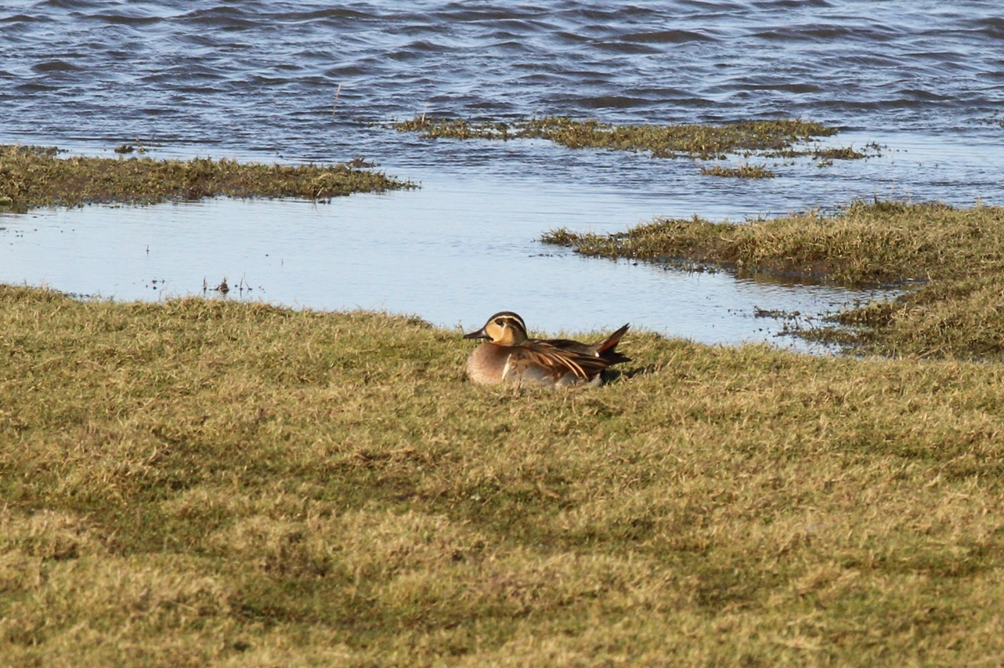
I sketched it in my notebook, and captioned the sketch ‘a lot going on’; it had a very complicated plumage which is difficult to describe. However, here goes. It had a complex head pattern which involved black area around the eye. A thin whitish line curved down the lower face from the rear of the eye patch and in doing so separated areas of buffy-yellow on the lower cheek and lores. The rear of the cheek and the area behind and above the eye was dull green, and again a very thin black line separated this from the adjacent yellow, whilst a very thin white line fringed the edge of the green on the neck. There was a thin white line between the green and the yellow and the dark brown crown. The upper breast was pinky-brown and the lower breast and flanks were grey, with a ‘Green-winged Teal’ white line and a less obvious white line between the flanks and the under-tail coverts. The under-tail coverts were black and the tail was grey-brown with orangey outer tail feathers. The back and wings were grey-brown with long mid-brown ‘aigrettes’ which were dark-centred. 

Phew! Incredible looking (and sounding!!!); and this was the ‘suppressed’ first-winter male version!

Baikal Teal at Crossens Outer Marsh, Southport, Merseyside, December 2013 (photograph credited to John Nadin).

Sunday, 18 May 2025

Green Heron – Red Wharf Bay, Anglesey, 16th November 2005

Later on on Wednesday the 16th November 2005 (having already duly banged in the Black Scoter at Llanfairfechan, as described in an earlier post https://collapsedbirder.blogspot.com/2023/06/black-scoter-off-llanfairfechan-gwynedd.html ) it was urgently back to the car and onwards to hopefully make it a two-bird day by doing the same with the Green Heron at Red Wharf Bay on Anglesey.

This had turned up there on Monday the 7th November 2005 (although it had probably been around for at least eight days before it was first reported). It had also been proven that this bird was the same one that had previously been seen at Schull in County Cork, Ireland between the 11th and 13th October 2005.

Time was of the essence; it was mid-November and so days were short and it was already reasonably late in the afternoon. I also had to get back to somewhere appropriate before Gary, Chris, Steve and I met up to go to Cologne for the weekend.

I managed to navigate and drive my way from Llanfairfechan to Red Wharf Bay without too many problems. On arrival I then managed to find the appropriate place to park. Then all I had to do was locate the bird, somewhere out in the salt-marsh creeks.

Again recollections beyond the very basic are minimal to say the least. Like at Llanfairfechan I think I was well and truly on my own, at least in terms of other birders. There may have been one or two but I really cannot remember. However, I think I can vaguely remember that there were locals walking and dog-walking alongside the salt-marshes and it just might have been the case that they shared their own inside information; the bird had been around for a considerable while by then and was something of a local cause celebre. I also dimly remember that I may not have had on the most appropriate footwear for the circumstances – I probably hadn’t considered it a priority to change my shoes, although these weren’t necessarily the best for tramping around the salt-marshes.

Whatever, I reasonably quickly and easily located the bird and spent some while following it (or attempting to get ahead of it to take photographs, as it was surprisingly close in the salt-marsh creeks). It moved very quickly though, so it wasn’t easily to keep up with (or take photographs of!).

I did so reasonably successfully though.

It was a small heron with a large bill. The upper-parts were mainly a dark browny-green with hints of iridescence. The cap was dark and separated from the back and wings by a rufous collar. The under-parts were a rufous (brick) red especially on the side of the neck and the upper breast, which was streaked with pale lines. The lower breast was white and streaked with rufous lines. The coverts had pale fringes. The bill was mainly dark grey although the lower part of the lower mandible was orange. The legs were greeny-yellow.

Seemingly, this bird was again (like the Black Scoter) the sixth individual ever to be recorded (although this includes a record from 1889 and a bird that was seen on both Jersey and Guernsey in the Channel Islands). In a curious way, it was long-term redemption; just months after I graduated from the University of Hull in 1982 just the second ever Green Heron turned up at Stone Creek in Holderness in late-November, but at the time I had just no idea about rare birds and quickly getting news about (and twitching) them. In some ways I regret never being part of the whole Nancy’s grapevine thing. As such, it wasn’t until the advent of Birdline in the 1980s that I could readily access such information. And then it was a downhill slope, as evidenced by these tales!


Green Heron, Red Wharf Bay, Anglesey, 2005 (photograph credited to Steve Young).

Tuesday, 13 May 2025

Kentish Plover – Ferrybridge, Dorset, 2nd May 1988

So, on Monday the 2nd May 1988 (presumably a Bank Holiday), Paul Pugh, who had again been visiting me in Dorset whilst I was working there, disappeared off to see a Greater Sand Plover at Dawlish Warren in Devon. Sure enough, Birdline almost immediately produced something much closer – I was ‘phoning from somewhere near The Fleet and the bird was at Ferrybridge – all of a couple of miles away, if not less.

So it was that I was able to tick off a Kentish Plover as it was feeding on the dried mud-flats.

It was a small, slim plover which had pale brown upper-parts, and white under-parts including the throat, neck sides, face and a collar. It had a rufous crown with a dark patch on the upper lores, a broad white supercilium, a dark eye-stripe which broadened and curved downwards behind the eye and a black patch on the upper-breast. It had a short, thin black bill and darkish-olive legs.

27 years and one week later, I finally caught up with another, the first for my Scottish list, at Tyninghame, East Lothian (a fantastic site, at which I had previously seen two Greater Sand Plovers).
Kentish Plover, Ferrybridge, Dorset, May 1988 (photograph credited to unknown).
I couldn't readily source a photograph of the bird I saw actually at Tyninghame on the 9th May 2025, but here's one, which, fantastically (on the basis of plumage details) is considered to be the same bird at Kilnsea in East Yorkshire on the 10th May 2025 (and it was then subsequently seen at Pegwell Bay in Kent on the 11th May 2025!!). The wonders of digital photography and social media! (Photograph credited to Colin Bushell).

Sunday, 11 May 2025

White-crowned Sparrow – Cley-next-the-Sea, Norfolk, 10th January 2008

Although it had apparently been around since the 3rd January 2008, the rather incredible news of a White-crowned Sparrow in Cley-next-the-Sea first emerged at midday on Sunday the 6th January 2008. Later that week I was with the erstwhile love of my life in Ryton-on-Dunsmore for my ‘regular’ six days or so with her until her children returned home on the following Sunday evening.

Obviously, on the basis of the mantra ‘go as soon as possible’ I was very keen to see the bird as soon as possible.

However, as the bird was in Cley-next-the-Sea in North Norfolk there was a counter argument to wait until Elizabeth was able to come with me. Just when this would be wasn’t necessarily clear, so in the end, under the pressure of dipping, I cracked and twitched from on my own on Thursday the 10th January.

North Norfolk from Warwickshire was an interesting drive. But, whatever, I successfully arrived in Cley in a timely manner and managed to park up. As it was both mid-week, but a few days after the news was released, the crowds present weren’t too large. I joined the crowd assembled alongside the Cley-Holt road opposite the house of the original ‘finders’, the Bendings,
 from where the bird could be seen when it came out to feed on the seed that had been scattered on the drive to facilitate the management of the twitch.

As a result of the management of the twitch and the timing of my visit I quickly and easily enjoyed excellent views of an adult White-crowned Sparrow in Cley, in January!!!! Not a bird I had particularly envisaged catching up with anywhere, let alone in these circumstances.

Having visited Texas on a birding trip in April 1992, and honeymooned and birded and worked and birded in California in 1997 and 2000 respectively, I was already familiar with Zonotrichia sparrows, but needless to say, this particular one got a good coat of looking at.

The under-parts were a pale slate grey merging into a more olive on the rear flanks. The face, neck, collar and upper back were also pale slate grey. The rest of the upper-parts were a complex mix. The mantle and the scapulars were same grey with russet brown streaking and the remiges and the coverts were similar but had black centres and white fringes or tips, which created two distinct wing-bars.
White-crowned Sparrow at Cley-next-the-Sea, January 2008 (photograph credited to Kit Day).


Saturday, 26 April 2025

Gray Catbird – Trevescan, Land’s End, Cornwall, 20th October 2018

Gray Catbird near Lands' End, Cornwall, October 2018 briefly attempting some blue sky thinking....... (I wonder whether there are any trans-Atlantic flights from St. Just?).

Between Saturday the 22nd September and Sunday the 14th October 2018, Ken and Amanda Shaw and I were in Shetland, spending three (yep, three!!) weeks on Unst. This involved, in effect, three different crews in each of the three weeks involved; the first week in was Pete and Nancy Gordon and Stuart and Barbara Benn, for example. Besides the ‘usual’ padders, we’d had some good birds, which included River Warbler, Citrine Wagtail, Pechora Pipit, etc., but we’d dipped Eastern Yellow Wagtail and struggled to find any really good birds ourselves. I’d also seen lots of otters. I’d enjoyed it – certainly socially, but it wasn’t 2016, but then again 2016 wasn’t going to happen every year (or indeed, any year, apart from 2016.....). We ended the trip with a bit of a flourish, seeing Pied-billed Grebe and Booted Warbler in South Mainland Shetland, and then, a short while before we had to go to Sumburgh Airport for our flight, Ken found a Shore Lark whilst stood right next to me to the east of Grutness Harbour. Ho-hum.

Once back home there was just a sense of ‘what might have been’, but I attempted to just return back to ‘normal’ life.

However, on Monday the 15th October, my sense of ‘what might have been’ went into overdrive as the news of a Gray Catbird near Land’s End came through on Rare Bird Alert.

Now, this was hard to hear. I very definitely had previous with Gray Catbird. And not in a good way, at all!!!!

I’d seen and heard them in Texas in April 1992, but then, when birding with Stuart Green on Barra on the 12th October 2009, we had heard a strange call coming from an area of recently planted scrub woodland that was predominantly alder in-between the Loch an Duin Reservoir and Brevig. It was a weird shrieking call.

Although we were both good at calls, we couldn’t quite place it; we tried to make it all sorts but in the ended we decided it sounded like an Icelandic race Redwing distress calling whilst a Sparrowhawk was dispatching it..... .

In trying to sort it out, Stuart remained on the road whilst I went in, full expecting to flush a Sparrowhawk, and find either a dead Redwing or some Redwing feathers. When I got to where Stuart was indicating, there was nothing, so the mystery deepened, or at least remained. Soon afterwards Mark Oksien and Stuart Rivers arrived in Mark’s mobile home, but if ever there were two birders you didn’t want to share a ‘we’ve just had a strange call’ story with, it was them, and they, and eventually we moved on, our story forgotten.

Or, not quite ..... . Many weeks later Stuart ‘phoned me, and suggested I should listen to something. He then played the call of Gray Catbird down the ‘phone..... . Somehow the acoustics involved made me even more sure that this was precisely what we had heard that afternoon on Barra. I felt sick. Stuart and I both knew what we had heard but it was all too little too late. What could we do with a retrospective ‘record’ of a heard only Gray Catbird? Stuart swore me to secrecy; what else could we do with a brutal tale of what might have been.

Later, when I read up on Gray Catbird, I discovered the species, ‘prefers alder thickets’ said the book. That helped. That helped a lot. FUCK!!!!!!!!!!!

When re-visiting this account recently, it has occurred to me that had it occurred some 15 years later we may just have (literally!) been way better equipped to cope with this set of circumstances than we were then. For example, had it happened in recent years we could perhaps have made a sound recording of our mystery call (and perhaps attempted to use playback to entice the bird into view?) and maybe identified the call more quickly from the sound recording (AND had evidence of our record!). And maybe we could just have used Merlin, and realised what we were hearing there and then!

However, all of this is now idle speculation, clearly. Useless.

So, yes, I had previous, and somehow the chance of at least partially banishing this hurt began to materialise. The bird ‘stuck’ day after day. A twitchable Gray Catbird? How was this possible?

Meanwhile, Paul Pugh had sorted out some top tickets for him and me to see U2 at Manchester Arena on Friday the 19th October. This involved staying overnight. I had arranged two rooms at the Copthorne Hotel in Salford Quays, Manchester.

As the bird continued to linger, I resolved that if it was still there on the Saturday morning I was going to drive from Manchester to Land’s End. As you do.

Therefore, I travelled from Edinburgh to Manchester on the Friday, rendezvoused with Paul, walked across Manchester, attended the gig (which was very good), returned to the hotel, crashed out and then awakened the following morning to the joyous news it was still there. Some eating and drinking was undoubtedly enjoyed the previous evening but I can’t remember too much about that. I do know that any plans for a leisurely breakfast were hastily abandoned as I wished Paul goodbye and departed for Land’s End.

Now, driving from Salford Quays in Manchester to Lands’ End isn’t a short journey. It took at least six hours, but again, Manchester is a lot closer to Land’s End than Edinburgh is, so I was striking whilst I had the chance.

I suspect it was around about 14:30 before I finally arrived almost as far west as I could drive in England.

The location involved a large area of scrub vegetation (bramble, bracken, etc.) on what was Treeve Common, between Sennen and Land’s End. The access arrangements were excellent; I pulled off the A30(T) into the field parked up, and, having gathered up my paraphernalia strolled across the field to the scattered group of birders at the other end of the field (later paying for the privilege by throwing some coins into the bucket on the way out).

There were perhaps fifteen cars already there, and so 20 or 30 birders at most. As suggested, the assembled birders were scattered near the field margin looking over the derelict Cornish bank into the scrub beyond. A few other birders were out on the Common itself and were looking into the scrub area from the other side. I sized up my options and went to the furthest away group of birders.

This was partly because they appeared to be the ones closest to the area being looked at. As I assembled my gear, I realised that I had opted to stand next to John Swallow, who had apparently just earlier that afternoon returned to St. Just from St Mary’s, having been in Rosenhill Cottage on St. Agnes..... . Small world!!!!! Anyway, I joined him, and over the course of the next hour or so, we had a very good chat and managed to see the bird on three separate occasions, at c.14:50, 15:20 and 15:45.

In general, it wasn’t showing, but with patience, very good views of what was by reputation a notoriously elusive bird were obtained as it slowly worked its way to the top of a clump of scrub and then remained there long enough to get the ‘scope on it. On the last occasion, it flew, carrying a blackberry, and we watched as it went past us into some nearby cover; supposedly where it roosted.

With that we both decided it was time to go. During my chat with John I had explained to him that I had travelled there from Manchester having seen U2 to night before. He asked where I was planning to go that night. I really hadn’t got as far as considering this. I no longer had the option of my traditional staging post in Chesterfield and wasn’t really sure about other options. Fantastically, John solved my problem me; I was invited to stay with John and Margaret in Kintbury near Newbury that night..... . After all the driving I had done in the past 24 hours it was a long drive there but nothing like as long as my drive to an unknown destination further north might have been. And Margaret was a wonderful hostess; I told John to make sure she didn’t go to any trouble, but she rustled up some fantastic home-made soup. Perfect. It really was the perfect end to a perfect day.

The bird was a first winter. It was similar in size and shape to something between a Robin and Song Thrush with a long tail which had a rounded end and was occasionally half-cocked. Its plumage was a concolourous grey (gray!) both in terms of the upper-parts and the under-parts, apart from the rufous / vinous(!) under-tail coverts and the black crown. It had a black pointed bill and black legs.

John and I left independently after the last flight view. As I drove east on the A30(T) through Cornwall I had a ‘phone call from Dennis Morrison asking me whether I wanted to go to Cornwall to see the Gray Catbird. I explained that I had just seen it having been in Manchester the night before. I strongly encouraged him to go for it despite the extreme distances involved. I assured him the best I could that the bird looked reasonably settled and told him he wouldn’t regret it if he did. I don’t think he did..... .


The scene of the twitch at Trevescan, Cornwall,

Gray Catbird at Trevescan, Cornwall, October 2018 (photograph credited to Dennis Morrison).


Monday, 7 April 2025

River Warbler – Boughton Fen, near Boughton, Norfolk, 15th July 1989

In early 1989 I had started work in London, but although I could cope with working there, I couldn’t cope with the idea of living there, so for a couple of weeks or so I prevailed on Gary Hitchen and his then wife Debbie and lived with them in Normandy Road in St. Albans. I then found a room to rent near to the city end of Lower Dagnall Street in St. Albans.

Gary and Debbie’s next-door neighbour, Steve Tossell, introduced Gary and I to The Farrier’s pub in Lower Dagnall Street, which was where the first branch of the Campaign for Real Ale was formed on the 20th November 1972. Although The Farrier’s was a tiny (but very homely) pub, not only did it have fantastic McMullen’s beer but it also had lots of interesting (and some not so interesting) clientele. Very soon, for instance, both Gary and I were playing for various of The Farrier’s football and cricket XIs. Better still, for me, Steve (who volunteered for the RSPB) wanted me to meet two regulars in particular, Peter Ewer and Mike Thompson, who he said were birders like me. The pub with everything! Sure enough, Pete, Mike and I did meet up, and quickly became friends.

So much so, that when a singing River Warbler turned up at Boughton Fen in Norfolk on Saturday the 8th July and then remained there for the next week that Pete asked me on the following Friday night whether I wanted to go with him and Mike to see it the following day.

So it was that on Saturday the 15th July that I was off on my first St. Albans team twitch with Pete (who had a car and always drove) and Mike (who had never learned to drive and twitch by public transport or by going with the likes of Pete). It was highly successful too.

After a leisurely start, we made it to the scene of the twitch in 1.5 hours. Once there, we then just had to stand and wait on the road adjacent to the fen scrub and reed-bed for the bird to appear, and sing, which it did, at regular intervals.

The song was amazingly loud and distinctive and was delivered from exactly the same song-post each time, at frequent intervals. As such, it gave good views as it quivered atop its perch; it was throwing its song out with its head right back as it was perched on a wild-rose bush.

It was a grey-brown locustella with a rounded tail, long-under-tail coverts, and a pale fringe to the closed wing. However, it also had streaking on the throat and upper breast, and white tipped under-tail coverts.

I suggested it was a memorable sight, which was one not likely to be repeated.... .

However, in June 1996 I saw one much closer (and even from my car) as it sang adjacent to a car-park near Kielder Water, in Northumberland in the first half of June 1996.

And then I saw one found by Peter Alley in the iris-filled gullies near Houlland on Unst in very early October 2018.

River Warbler, Boughton Fen, Norfolk, July 1989 (photographs credited to Peter Ewer).


Wednesday, 2 April 2025

Caspian Tern – Stanpit Marsh Local Nature Reserve, Christchurch Harbour, Christchurch, Dorset, 16th June 1988

Unfortunately, again, contemporaneous notes are somewhat lacking in this instance. However, the bird in question was seen on both Thursday the 16th and Friday 17th June when, at least on the latter date, I would have been conveniently passing by as part of my work on the Purbeck to Southampton Pipeline Project..... . or something like that. Obviously. 

Shamefully, I can remember little about the bird. 

Even more shamefully, I can remember even less about my initial twitch on (I think) Thursday the 16th June. 

However, Alison Downs (nee Bunting), who was my girlfriend when I was working on the Purbeck to Southampton Pipeline project in Dorset and Hampshire, is always keen to tell me that, when the news broke, we were apparently just on our way off out for a meal. As such, seemingly she was dressed in high-heeled boots, and a purple Christian Dior knitted skirt with a long pearl necklace. Quite a look to be rocking at a twitch on the saltmarshes around of Christchurch Harbour. Meanwhile, clearly, I was just the scruffy bloke with her.

Sadly, there are no photographs to illustrate this account, neither of Alison all glammed up, nor of the Caspian Tern. It was a long time ago, after all.

Although I don't remember the details that Alison is always so keen to remind me of, I do remember that the bird frequented the mudflats of the harbour and was seen both resting on and flying over them. It was clearly a large tern approaching the size of Herring Gull with a black cap, forked tail and heavy, bright orange-red bill. It was highly distinctive from a distance, as a large grey and white, black-capped, orange-billed tern.

Many, many years later (28, in fact) in July 2016, I saw a well-travelled one-day bird at Carr Vale Derbyshire Wildlife Trust Nature Reserve, whilst visiting my father in Chesterfield. Carr Vale was the scene of walks with the girls and their grandad when they were young and, subsequently, a place where I did various bird surveys whilst working on the ill-fated leg of the HS2 Project in Derbyshire and Yorkshire. 

In lieu of a photograph of the June 1988 Alison Bunting or Stanpit Marsh Caspian Tern, I managed to locate a photograph of the July 2016 Carr Vale Caspian Tern.
Caspian Tern, Carr Vale, Derbyshire, July 2016 (photograph credited to Peter Gerrity).