Friday, 24 January 2025

Eye-browed Thrush – Setter, Fair Isle, 4th October 1992

Thanks to Russell Cooper, and also Elizabeth Harvey and Roger Riddington, I was saved from missing a really good bird, i.e., Eye-browed Thrush, despite having ignored the Fair Isle maxim, “Never go north in the afternoon,” (on the basis that if something turns up elsewhere in the afternoon you might miss it when it goes dark before you can get there).

I subsequently wrote up the circumstances for a, “My Best Days Birding in Scotland” article which was published in Birding Scotland in October 2001 (Birding Scotland Volume 4 (4) pp. 146 – 149. This is replicated here:

My Best Days Birding in Scotland – Brian Minshull

I had to think long and hard about my best days birding in Scotland. Not that I was necessarily overwhelmed by choice. I hasten to add that this is more a matter relating to my personal circumstances as opposed to any lack of opportunity for good birding here in Scotland. My work on pipeline projects often takes me away from home so that any birding has to be crammed in on occasional trips to the field on weekends at home or when I am ‘between projects’, as we short-term contract workers say. Domestic circumstances have also compounded this situation; in the past four years I have got married and had two daughters, moved house and worked in each of Peru, California and Turkey for several months.

I have been resident in Scotland since early 1992, when I first moved to the Queensferry area to work on a BP Project that doubled the export capacity of the facilities at Hound Point and Dalmeny. That year I took the chance to go to Fair Isle for two weeks during the first half of October. This would be my first visit to Shetland and Fair Isle at this time of year although I had been to Foula on two seabird ringing expeditions in 1979 and 1980 and more recently a friend and I had visited Scotland to ‘do’ the Scottish specialities in May 1990. This trip culminated in a few days on Shetland and Fair Isle allowing us to jam in on the Pallas’s Sandgrouse. I had also been to Shetland on a couple of other occasions for out and out twitches, with mixed success. The Sandhill Crane in September 1991 set off for Holland at precisely the moment I committed to purchasing tickets to fly from Manchester to Sumburgh, whereas the Pine Grosbeak in April 1992 was somewhat more obliging, and showed brilliantly for the duration of my visit to Lerwick between St. Clair sailings.

As such expectations were high – two weeks on Fair Isle at around about prime time. All the more so after I had two ticks on mainland Shetland on the 2nd October as my friend Pete Ewer and I travelled from Edinburgh to Fair Isle; Dusky Warbler and Black-headed Bunting.

On arrival on Fair Isle we found a collection of well-known birders including Mick Turton, Tom Francis and Doug Page already there. In addition, there was Russell Cooper, a real character from my native North-East Lancashire and someone I had previously met in the Scillies. Meeting up with birders such as these simply added to my expectations.

The next day, our first full day on Fair Isle, produced some good birds including one Olive-backed Pipit and one Pallas’s Warbler as well as several species with a winter flavour, including Brambling, Lapwing, Lapland Bunting, Jack Snipe and skeins of geese.

On the 4th October, the day in question, the weather was anything but in keeping with such birds, as it was a day reminiscent of some days during October in the Scillies, calm with unseasonably warm sunshine. As is evidenced by the accompanying photograph I was intent on making the most of this. Having gone south towards the crofting areas in the morning with similar results to the previous day, including one Pallas’s Warbler, two Yellow-browed Warblers, one Olive-backed Pipit and one Woodchat Shrike, I decided to ignore the popular convention of, “Never go north in the afternoon”. This maxim is given in order to prevent people missing goodies that are discovered in the crofting areas late in the afternoon only to disappear that night. For whatever reason though I sent off in tee-shirt and shorts (yes, it was that warm) for a walk along the cliffs in the north and west of the island, away from the more ‘intensive’ birding in the south.

he birds I had seen earlier were good enough, but perhaps I wanted to do my own thing and find my own birds rather than see those found by others. Going north would give me the chance to do this. Nothing too exciting was seen between the Obs and the North Light; my notebook records one Guillemot, one Great Skua, three Teal at Golden Water and on Wheatear, but once at the Light things started to happen.

As I worked my way through the assorted pipits feeding on the short-cropped turf on the cliff-tops adjacent to the lighthouse one appeared to be an obvious Olive-backed Pipit, a species I had been watching closely just a few hours earlier ‘down south’ so I suppose I had ‘got my eye in’. My memory and notebook do not serve to remind me whether I was initially alerted to its presence by a call or not, but nonetheless, there it was. Now it is not every day you find an OBP, and although it was a little disconcerting seeing one feeding with Rock and Meadow Pipits in the atypical setting of short-cropped turf as opposed to some sort of denser cover, I was happy enough with my initial i.d.; this was Fair Isle after all. Indeed, so much so that I took the opportunity to show it to Mrs Stout, who like several other islanders that Sunday afternoon was day-tripping to North Light, as you do.

I got my ‘scope onto it so that I could let Mrs Stout have a look, (although she had probably already seen umpteen OBPs). During the usual process of, “Now let me get the ‘scope back on it – right it’s in there now”, I was somewhat bemused when another pipit, looking just like ‘my’ OBP, walked into view and past the bird we were looking at. A crisis of confidence ensued – was I stringing OBPs, and misleading the good Mrs Stout?

Fortunately, meanwhile another family of islanders had arrived, and as the family was the Riddifords, help was at hand, the former warden of the Obs would put me right.

I called Nick over, and explained my predicament. I suppose I could allow myself to believe I had stumbled onto one OBP, but two seemed a little careless. So somewhat reluctantly, I told Nick that I had been watching what I was sure was an OBP with Mrs Stout when another had walked past it. I got him onto the birds and asked him to confirm my i.d.. Unfortunately, they had continued moving along the cliff top and as a result the light was less than clever, but Nick was able to confirm they certainly looked good for OBPs. He couldn’t be 100% sure, because of the light, but said they looked good.

So I wasn’t cracking up then, and buoyed with re-found confidence I volunteered to move around the birds in the hope that they would return back to where I had first seen them, and so into better light for Nick.

This I did, but unfortunately the birds didn’t agree my plans and flew, calling as they did so. They flew towards Nick and he gestured ‘two’ (or at least that’s what I thought he was doing, although he may have been enraged by my careless flushing!). Anyway, I set off back towards him, and as I did so two pipits flew overhead giving the same distinctive call we had just heard. By now things were getting out of hand; were these birds the same two which had just come around in a big circuit, or two more? Nick congratulated me on my find and we discussed the ‘two bird’ situation before I continued on my way, leaving the various islanders to enjoy their Sunday afternoon constitutional.

All exhilarating stuff!

As I left the North Light area I had a flock of 22 Siskin and on Easter Lother Water there was a Dunlin. However, my notebook and memory don’t begin to do justice to the events of the next couple of hours as I walked around the clifftops from North Light to Burrashield in ‘perfect weather’. Time and again, I would arrive at the top of a geo and find it crawling with birds. I would sit at the edge of the cliff overlooking the grassy slopes at the top of the geos and work my way through the migrants flitting about. Often they were ridiculously close to me. I guess the warm weather meant that they were working their way up the cliffs and into the upper reaches of the geos with the result that I had concentrations of migrants to work my way through. Nothing too spectacular but nonetheless, absolutely fantastic birding. It was hypnotic in a way; I knew I could be missing out if something was found in the south of the island but it was addictive, drug-like, as anything could be around the next corner, or rather in the next geo. Sitting at the top of geos in warm sunshine searching through warblers for goodies and surrounded by interesting geology and botany was superb.

By the time I reached Burrashield I had clocked up two Yellow-browed Warblers, three Ring Ouzels, four Redstarts, eight Blackcaps, one Garden Warbler, one Chiffchaff, six Goldcrests and four Robins in the various geos at the back of Ward Hill. Nothing too stunning, but extremely enjoyable as the walk was in fantastic scenery and weather and there was a mix of satisfaction and expectation throughout; I felt as though my decision to do my own thing had more than paid off.

Reluctantly then, I tore myself away from the cliffs and down over Burrashield and Sukka Mire towards the airfield, seeing three Short-eared Owls on the way. As I descended I must have been highly visible to those birders in the crofting areas and also to islanders attempting to enjoy the day of rest in my lurid combination of white tee-shirt, orange shorts and pink skin.

Despite my excellent few hours birding I suppose I had some misgivings about what I might have missed. Luckily my lack of subdued clothing, (contrary to another oft-repeated birding maxim) was to be my saving grace.

My notebook kicks into life here, so I’ll quote directly.

“Having spent an exhilarating few hours on the North and West cliffs – two Olive-backed Pipits and two Yellow-browed Warblers amongst my many finds, I made my way down from the tops to the airfield. Here, whilst reading the National Trust for Scotland sign, I was rescued by a running Russell Cooper, who blurted out the words, “Brian, Eye-browed Thrush.” I ran towards Setter, to be rescued by Elizabeth (Harvey) in the mini-bus, and delivered to my destiny. I got dropped off at the School, and from there, continued my run to those still watching the bird at the back of the crofts at Field and Barkland.

Here the assistant warden (Roger Riddington) soon had me onto it, the bird amongst the Redwing. And what a bird! It was on a sloping area of the next field, feeding with 20 or 30 Redwing. Superficially similar to the Redwing with similar upperparts including head. This was distinctively patterned with an obvious white supercilium and a crescent around the rear of the ear-coverts and extending towards the base of the bill. The upperparts were a rich brownish orange.”

Evidently, when the bird was found it became apparent that I was not around and to my eternal gratitude Russell had firstly scanned the hills until he spotted me and then legged it to the airstrip to tell me the news!! I can picture him now gasping for breath and blurting out those words.

The Eye-browed Thrush was a tick for me and coming at the end of a day which had also involved me seeing one Pallas’s Warbler, two Yellow-browed Warbler, one Olive-backed Pipit and one Woodchat Shrike and finding two Olive-backed Pipits and two Yellow-browed Warblers suitably completed the day.

This all meant that I had a lot of writing up to do. Paul Harvey, the then warden, asked me to write up a description of the Olive-backed Pipits and having heard about this multiple occurrence had to take me to one side and urged me to ignore what others, including a previous warden of FIBO, was saying about how many birds were involved and tell him how many I thought were involved!

I am still not entirely sure, but the British Birds Rarities Committee report dutifully records “…another two, possibly three, 4th …(R. Minshull……)” . Got my name wrong again, as they did the previous time I had submitted a record, but you can’t have everything.

That night, courtesy of Dave Suddaby, plans were made for a boat to North Ronaldsay so that the twitchers amongst us could see the Siberian Thrush there, and as good as that twitch was it did not compare with the previous days eventful birding, my best days birding in Scotland.

Footnote: During the process of writing this article I dug out a photocopy of the description I submitted for the pipits. This refers to another sheet on which I think attempted to explain the circumstances involved. Unfortunately, I didn’t have a copy of this and so for that ‘quoting from notes made at the time’ feel I tried to get hold of a copy of this account, firstly by contacting FIBO, and then Paul Harvey, with no luck. However, during the course of our conversation Paul told me he had been to North Light that morning and had heard what he thought was probably OBP, and adding to the confusion had also had two Tree Pipits there! Also, apparently, Nick Riddiford had submitted his own description of the OBP’s as well. All this was in the middle of what proved to be a ‘mini-fall’ of OBPs on Fair Isle.

Eye-browed Thrush, Setter, Fair Isle, October 1992 (from the BBRC Report for 1992).
In October 1993 I saw another on St. Mary’s and also, it, or another, on St. Agnes.
Eye-browed Thrush, St. Mary's, Scilly, October 1993 (photograph credited to unknown).


Friday, 17 January 2025

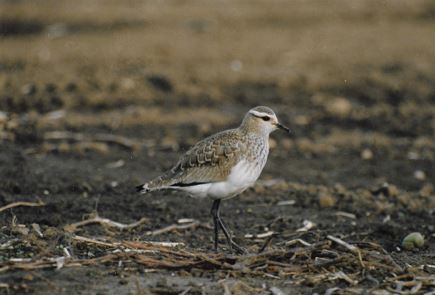
 Sociable Plover – Welney, Norfolk, 21st October 1990

Mid-October 1990 saw me have an incredible run of ‘doubling-up’ – getting two ticks on the same day.

Not consecutive days, admittedly, but all the same….. . 

It involved a stunning sequence of good birds – providing two new birds for my ever burgeoning list on five separate days – Upland Sandpiper and Swainson’s Thrush on the 12th, Red-throated Pipit and Penduline Tit on the 17th, Western Bonelli’s Warbler and Grey-cheeked Thrush on the 19th, Little Bunting and Black Kite on the 20th and now Parrot Crossbill and Sociable Plover on the 21st October! Incredible times!

Having earlier twitched Parrot Crossbill and Pied Wheatear at Holme on the North Norfolk coast, Pete Ewer, Bill ?????? (the old boy Pete used to bring on some such escapades) and I returned back through rural West Norfolk, to the intensively farmed flatlands north of Welney.

Here, after a yomp across several fields chasing a Lapwing flock which didn’t want to play, we finally got views of our bird.

The views at this time were distant. As such, as we edged closer, probably due to our presence, the flock would roll away from us, enabling the Sociable Plover to be picked up in flight and then on the ground.

Fortunately, these views were nothing though compared to those obtained later. However, it was the only time the distinctive black and white wing and tail pattern was seen. Otherwise, all that was gleaned at this time was that it was buffish light brown overall, with paler under-parts.

Later, it was seen very well and much closer, and as such it was closely watched for a long time. It had a prominent supercilium which accentuated the capped appearance, and a dark eye-stripe and eye. It had pale fringes to the upper-parts, a streaked upper-breast, dark primaries, and long scapulars. Predictably, it had a plover-like dark bill and long dark legs.
Sociable Plover, Welney, Norfolk, October 1990 (photograph credited to Peter Ewer).
Sociable Plover, Welney, Norfolk, October 1990 (photograph credited to Robin Chittenden).


Wednesday, 8 January 2025

Great Spotted Cuckoo – Dawlish Warren Local Nature Reserve, Dawlish, Devon, 25th March 1990

Another!! Two difficult birds in one weekend! The day after the Bonaparte’s Gull on the lake in Abbey Fields, Kenilworth in Warwickshire we took different motorways – the M25, M4 and M5 south-west from St Albans to Exeter and beyond to Dawlish and Dawlish Warren in Devon, where the object of our mission had been since Tuesday the 20th March. Why we saw the Bonaparte’s Gull on the Saturday and the Great Spotted Cuckoo on the Sunday when both were available of both days is not evident at this remove. Perhaps it was Pete Ewer’s idea of crowd management.

Once again, like the twitch the previous day, we saw very little other than our target but that was more than enough.

We watched it both feeding on the ground amongst the sand-dune vegetation, when it had an upright stance and an ambling, somewhat ponderous gait, as it picked off and devoured hairy caterpillars, and flying over the sand dunes, when, if not struggling against the wind, it had a rapid twisting flight.

It had buffy-white under-parts and collar and grey-brown upper-parts with white barring / spotting on the coverts, etc.. It also had russet primaries and a very long graduated brown tail. It had a contrasting dark brown hood (which was similarly extensive like that of the Sardinian Warbler of a few weeks earlier) which was ‘punk’ spiky.
Great Spotted Cuckoo, Dawlish Warren, Devon, March 1990 (photograph credited to Pete Wheeler).

Sunday, 29 December 2024

Desert Wheatear – Barn Elms Reservoirs, London, 13th April 1989

Having started work with ERL (now ERM) in London in early 1989, I lived for two or three weeks with Gary and Debbie Hitchen at their home in Normandy Road, St. Albans, before finding my own accommodation, a room I rented from Sue Clacher at 11 Lower Dagnall Street, St. Albans.

On the evening of Wednesday, the 13th April, whilst recuperating at ‘home’ after a hard day at work in Central London (involving commuting between St. Albans and Baker Street and Baker Street and St. Albans each day) I received a ‘phone call from Paul Pugh. The gist of his call was that there was, “A Desert Wheatear just down the road from you”. Now, I argued with him that description of ‘just down the road’ did not really apply to 
to Barn Elms Reservoirs (now the Wildfowl and Wetlands Trust’s London Wetlands Centre) in west, central London and on the south side of the Thames, given I was outside the M25, well to the north of London.... .

However, although it was well gone 18:00 and a long way to go, in my decrepit Ford Capri, as, especially after a long day’s work, I was grateful for the news. I was though, thrown into a quandary by the dilemma that faced me, or that I was faced with...... .

All the same, I decided to go for it. Driven by nervous tension / exhilaration and / or an idiot, more by luck than judgement than anything else, I made it; I successfully navigated there completely by instinct. I also successfully parked wherever I could and then rushed to the scene whilst there was still some light.

In doing so I got good views of my quest. My abiding memory was just how this stunning looking first summer male Desert Wheatear had somehow managed to find desert in Central London; it was feeding on the disused sand and gravel filter beds adjoining the reservoirs!! Nature is just incredible.

It was a real goodie. It had a solid black tail and white rump, and the black face mask which almost connected with the black of the primaries, secondaries and coverts, and otherwise the plumage was a very pale sandy brown.

Early(?) the following evening Paul descended from Wigan having twitched / before going to twitch the Desert Wheatear, complete with a car full comprising a very young Billy Aspin, Tony Disley and Dave Broome. When they arrived at the front door of Sue’s house Paul introduced Billy and Tony as being from Blackburn, and I couldn’t resist saying in my best Mr. Angry voice, “Blackburn, Blackburn???? They can fuck right off!!!” Billy in particular looked mortified (he almost cried) and almost pleaded with me to let them stay despite he and Tony being from Bastardville..... .

Anyway, this was arranged with the very obliging Sue, and later on, they all crashed for the night in the front-room of her house. This was fine, except that during the night Dave, who always was a complete stick insect, got cold, and proceeded to attempt to pull the throw which was on one of the settees off for extra warmth. He successfully did so, except the throw was secured to the settee with safety pins, so he ended up ripping big holes in it...... . Fortunately, Sue was very patient.... .

Further Desert Wheatears (females / immature) followed in rapid order. Pete Ewer, Mike Thompson and I saw one at Selsey Bill in West Sussex a few months later in early November 1989, and then Carol Carrington and I saw one at Rossall Point near Fleetwood in Lancashire two years later (and bumped into Pete Ewer and Angela Coward there!).

I then saw a second Desert Wheatear on the Fylde in Lancashire in November when I saw a first winter male near Blackpool Airport, Blackpool in 1994. And lastly, in December 1997 or January 1998 I saw a first winter female at Musselburgh in Lothian.

After five in less than ten years, somehow they seemed to have dried up (at least for me!) since then.
Desert Wheatear, Barn Elms Reservoirs, London, April 1989 (photographs credited to Peter Ewer).
Desert Wheatear, Selsey Bill, Sussex, November 1989 (photographs credited to Peter Ewer).
Carol Carrington and Angela Ewer checking out the Desert Wheatear and/or Peter Ewer at Rossall Point, Lancashire, November 1991.

Monday, 23 December 2024

Crag Martin – Church of St. Mary and All Saints, Chesterfield, Derbyshire, 10th November 2015

In mid-November 2015 I was committed to visiting my dad for a few days; I had planned to drive from home in Edinburgh to Chesterfield on Tuesday the 10th November. However, circumstances transpired which caused me to very rapidly bring these plans forward...... .

At midday on Sunday the 8th November the incredible news of a Crag Martin flying around the Crooked Spire in Chesterfield arrived on the pager. So, when this was still being reported the following day, the impossible seemed to potentially be becoming possible, and I opted to disappear off to Chesterfield a day before I had originally planned to do so.

Possibly due to indecision and a confusion of things to do before I departed, I had no chance of seeing the bird that day (the light would have gone by 16:00 and at the best of times it was a five-hour journey).

Therefore, I was reconciled to trusting to luck and getting there the following morning.

Being that it was in Chesterfield, a place I had known since my father had moved there in the late 1970s, I was more than aware of just where it was. As such I knew there was very limited parking nearby, or, more accurately, that any parking there was would be very expensive, especially so if the bird proved not to be co-operative.

For this reason, early the following morning (but not that early, it was mid-November!), I drove from Wingerworth to Hasland, and then along the old Hasland Road to where this had been severed by the A617 dual carriageway. Here I parked up, gathered up my gear and then walked through the under-pass under the mainline railway, to the roundabout at the start of Derby Road and from there up into the town centre along Lordsmill Street and St Mary’s Gate to the St. Mary’s Gate car-park, where a good few birders were already waiting.

I joined them for what proved to be an increasingly nervous wait. It was just gone 07:30 when I first arrived. But an hour and a half later I could not help thinking it had either demised in the night or was a very late riser (or maybe the assembled birders were too busy chatting and had missed it and it was feeding elsewhere as it had on the previous day?). Apparently it had even sullied itself by feeding (and roosting?) at the Proact Stadium..... .

The wait was a little improved by seeing various faces in the crowd that I recognised from the Scillies or wherever. It was just that they were 15 or 20 years older! I also chatted to Dave Graham, the farmer / birder from the Borders who, I think, was there with Dennis Morrison.

Anyway, eventually, it turned out it was just a late riser (not too many insects around early on a November morning in Chesterfield) as all of a sudden it was there!! We variously moved to the pavement alongside St. Mary’s Gate and the buildings opposite the church from where we could watch it twisting and turning around the Crooked Spire overhead, all whilst we were trying to be not too much of an obstacle for the more legitimate users of the pavement and not to be too much of a spectacle for those going by in cars, buses, white vans, etc. (with mixed success....... ).

It was a completely spectacular bird to watch. It was incredibly fast in flight, and also incredibly erratic – almost like a bat, switch-backing through the airspace. Fantastic!!!! I watched it for two hours or so. Another rarity in Derbyshire, to add to the Black-throated Thrush..... . But let’s not go there with rarities in Derbyshire (given my Yellow-nosed Albatross ‘near-miss’!!!). Predictably, it was a first for Derbyshire, and only the tenth for the Britain. Given the speed it moved at in flight, it was hard to get good views of some of the features including the tail spots (arm-ache was definitely a feature of this particular twitch!). It was a ‘chunky’ hirundine, which was overall grey brown but lighter on the under-parts than the upper-parts. It had a broad, square-ended tail and dark under-wing coverts.
All in all, a truly memorably twitch, in no small part due to the setting, right in the middle of Chesterfield (I watched it metres away from where Tessa had once nearly fainted as we were about to cross the zebra crossing outside the public library, for instance).

Although it remained until the 15th and therefore throughout my stay with Dad, I’d had very good views and didn’t bother going again. However, I do have a vague memory that subsequently I drove through Chesterfield past the scene whilst encouraging presumably Dad to look up out of the passenger window of my car as we drove past!


Crag Martin at the Crooked Spire, or, more formally, the Church of St. Mary and All Saints, Chesterfield, November 2015 (photograph credited to Andy Butler).

Friday, 13 December 2024

Terek Sandpiper – Stanpit Marsh Local Nature Reserve, Christchurch Harbour, Christchurch, Dorset, 16th July 1988

Whilst I was working in Dorset and Hampshire in 1988, Birdline conveniently notified me of this goodie at the handy Stanpit Marsh on the outskirts of Christchurch, and so it was off there I went from work on the Purbeck to Southampton Pipeline on the morning of Saturday the 16th July after ‘notifying others’ (whatever that means from a distance of 36.5 years later....).

I arrived at Stanpit Marshes to be rewarded with views of this bird feeding on the margins of the islands in Christchurch Harbour, and also flying closer, alighting briefly in front of us. Good views of a good bird.

It had grey-white under-parts and grey brown upper-parts with a diagnostic black line on the scapulars. It had a long, stout, slightly upturned dark bill and medium length stout orangey-yellow legs. In flight it had a grey rump, and a paler trailing edge (and a darker leading edge to the primaries, etc.), to the wing.

Subsequently I saw the one at Kitty Brewster on the Blyth Estuary in November 1989, although it may have been later, as presumably the same bird was then there and / or nearby from January 1990 until January 1991.

Finally, and incidental to all of this, one of the accompanying images was taken by Martin Reid, who was then a birder based in Dorset. Move on less than four years, and it was Martin, having moved to Texas, who provided the excellent image of the Wandering Tattler (a first for Texas) Mike Thompson and I found at Galveston, which accompanied the description we submitted to the Texas Bird Records Committee of the Texas Ornithological Society. Small world indeed!!

Terek Sandpiper, Stanpit Marsh, Christchurch Harbour, Dorset, July 1988 (photograph credited to Martin Reid).
Terek Sandpiper, Stanpit Marsh, Christchurch Harbour, Dorset, July 1988 (photograph credited to David Cotteridge).

Sunday, 8 December 2024

Siberian Accentor – Mossy Hill, near Scousburgh, South Mainland, Shetland, 10th October 2016

So....... . October 2016. We had been in Shetland for just over a week, during which we had seen plenty, including Paddyfield Warbler, Arctic Redpoll, Siberian Thrush and White’s Thrush on Unst, and Swainson’s Thrush on Fetlar and Brown Shrike on North Mainland (and that was only the real highlights).

Saturday the 8th October involved a change of crews – in effect, we were losing Jonny Holiday and Chris Pendlebury and gaining Paul Collin and Dennis Weir.

This involved someone driving from our excellent Noosthamar (Shetland Nature Lodge) accommodation to Sumburgh and back; given that there was a potential tick for him nearby and there were new allies to make, John Nadin (until now completely reluctant to drive) volunteered.

No surprise, then, when the next day, John again commandeered the driving of the vehicle so he could influence just where we were going..... .

Amongst other things the partial change of crews meant we no longer had the instantaneous bird news updates from Twitter that Jonny and Chris provided. It was not yet clear what news sources Paul and Dennis used. As such, given that Ken had sent his RBA pager off for repair prior to the trip and then managed to drop his mobile down the toilet at the appropriately named Final Checkout shop and garage, so completely incapacitating it and the RBA app. it included, we were now even more dependent on the news updates I was able to provide; oh, and those that John was also able to provide on an erratic / eccentric basis...... .

Therefore, keeping in touch at all times was going to be even more important.

That morning, we visited the plantation near Baltasound Middle School, for old times’ sake maybe (this being where we had found the White’s Thrush the previous October). To further the nostalgia I once again thrashed through the under-storey of the stunted Sitka spruce. In doing so I managed to lose a contact lens as a branch whipped back against my face. As such, I was reduced to a one-eyed birder, which was completely rubbish.

Later, when we all returned to Noosthamar for late lunch, I was still very much less than impressed with my ill-luck, and so, after eating, without saying anything to anyone, walked up the hill to ensure I had ‘mobile reception and commence the tedious and tortuous process of struggling to locate the right number to ‘phone Boots Opticians at The Gyle in Edinburgh and then cope with the interminable ‘press x for...’ options, and manage to convey the predicament I was in and (hopefully) arrange for a new lens to be manufactured, supplied and posted out to me, so that I would have it when we briefly called in to my flat in Edinburgh en route between Shetland and the Scillies.

All a very fraught process, taking way longer than was anticipated, or desired.

As such, when the team bus suddenly appeared coming up the hill, being driven by John and loaded up with the rest of the crew, I only briefly chatted to them as they pulled up, before I simply waved them on.

Once I had finally completed my call I walked back down to Noosthamar, I casually checked Facebook. It was by this means that I was first alerted to the presence of the first Siberian Accentor for the British Isles on South Mainland Shetland..... . 

WWWWWWWWHHHHHHHHAAAAAAAATTTTTTTT????????

The news had seemingly just broken. I was already half way back down the hill to the house. I was also in a daze.

I continued back into our place and in doing so opted to use the landline there to try to contact the crew. I ‘phoned each of Amanda (as Ken ‘I have dropped my mobile down the toilet’ Shaw’s proxy), John, Paul and Dennis. In each instance, it either rang and went to voice-mail or just went to voice-mail, respectively, so I left the same basic message; “I am not sure you will get this voice-mail, but there is a Siberian Accentor on South Mainland and you need to come back to the Nature Lodge now.......!!!” Aaaargh! In desperation, I also rang Brydon Thomasson and left the same message.

Ken and Amanda had opted to walk to the Shore Station at Burrafirth, and indeed, in my dazed state I had seen them walking along the road at the head of Burrafirth towards there. But soon after two cars had travelled away from the Hermaness car-park. I could no longer see Ken and Amanda. Had they got a lift from passing birders? Was I in danger of being left behind???

I decided to set off walking to at least get out there and get mobile reception again, just in case they were trying to ‘phone me. Indeed, as I got back into reception, I got a voice-mail from Amanda telling me she had indeed got my voice-mail and they were walking back. Amusingly (or as amusingly so as was permissible in the circumstances), half way through the message, Ken had seemingly grabbed the ‘phone off her thinking she was actually speaking to me, and started shouting excitedly down the ‘phone, only for Amanda to try to explain to him she was not actually speaking to me....... .

Anyway, I walked towards the Noosthamar junction, and in doing so, intercepted Amanda coming the other way. She, in effect, told me that Ken had sent her back to base as the twitch had the potential to be, “Less than pretty”. Meanwhile, he was walking towards Haroldswick in the forlorn hope that John, Paul and Dennis would be rushing back to collect us and whisk us south for our appointment with this stonking first for Britain and Ireland on South Mainland.

I decided it would be best if Amanda and I followed Ken, and we did so, walking down to the Noosthamar junction, and then towards Haroldswick in his wake. Several times I bellowed, “Ken”, in his direction, but sadly, I am no Ken, and he didn’t hear me.

Eventually, though, he realised we were following him, having reached the Haroldswick junction and turned around, desperately wondering where the hell they were.

We quickly exchanged our stories and then decided we had no real option but to set off back. This we did, but even so, getting back long, long before they finally did.

By the time they did arrive back it was late afternoon. It quickly emerged (under interrogation 😊) that each of John, Paul and Dennis had left their mobiles on charge at base camp....... .

So, in effect, John had finally got my voice-mail only once he had finally returned..... .

With massively commendable restraint Ken and I pointed out the error of his ways to John. If he was going to commandeer (the responsibility of driving) the vehicle, certain basic responsibilities, like being in constant touch with the other crew members, came with it!!!!!!!

Typically, John flailed around and suggested, “What about them?” i.e., that he was only as culpable as Paul and Dennis. Ken and I managed not to over-react to this; basically John, one way, or the other, was the ‘senior’ member of the crew involved, having been on Unst for more than a week rather than just a day, and should have know better.

That said, we were all equally culpable in some ways – circumstances had really conspired against us what with Ken not having either his pager or his mobile and RBA app, me losing my contact lens and opting out of the afternoons' activities (so leaving the crew without their usual ‘go-to’ info source after they had set off, even if they had realised the consequences) and each of John, Paul and Dennis making the potentially fatal error of assuming mobile ‘phones were an optional extra.

It could have all ended in some very serious tears; when the news broke we could probably have still made it all the way to South Mainland in time to see it, albeit that it might have involved rubbish views in failing light. However, such views would have been better than no views at all if the bird wasn’t there the next day. After all, this was an unprecedented first for Britain and Ireland.

What followed was a fraught night; John later admitted he was feeling terrible, given that we might all miss out on this mega mega.

The following morning we departed early and successfully caught early ferries from Unst to Yell and from Yell to North Mainland.

Given the circumstances the journey went very serenely – largely thanks to Paul’s excellent driving, oh, and the positive news we got relatively early on during the journey, plus my interpreting of the RBA directions, although we did take on wrong turn when searching out the summit of Mossy Hill, as directed. However, this was a minor error, and we quickly recovered our way, and followed the correct (and marshalled!) route to the small quarries in the hillside, alongside which were some 16 vehicles and 50 or so birders.

There then followed a comparatively relaxed hour or so at the twitch with the bird generally on show as it grubbed around the rock debris and vegetation that covered the floor of the quarry. Encumbered by wearing my glasses and feeling very unsteady on my feet, I opted to take up a position looking down into the quarry from the top of one of the banks alongside side it; the quarries had been hewn into the side of the hill and the road ran diagonally along the slope at a gentle incline. Birders were in position at the entrance to the quarry and along the top of the lower bank.

From the latter location I had epic views of an epic bird which showed really well down to a few metres; a ‘scope really was optional.

In circumstances strangely / predictably reminiscent of watching a Radde’s Accentor in cool morning light on a mountainside near Demirkazik in Turkey (albeit that was a bird singing atop a scrubby bush as opposed to grubbing around a scruffy quarry) I thrilled at the scene before me. A ‘monstrous’ accentor doing its thing metres away, disappearing and reappearing amongst the rock jumble, feeding unobtrusively away, largely unconcerned by the crowds of birders metres away (apart from occasionally when the cacophony of shutters firing off shots sounded like mini-machine guns when it really performed!).

In typical accentor fashion it grubbed about feeding, memorably, at one stage, tossing leaf litter over its shoulder in a feeding action reminiscent of Turnstone.

My sketch notes made at the time suggested it was like ‘a robust Dunnock with a Shorelark head’ and it had a buffy yellow throat and supercilium, a black ‘robber’s mask’ black cap, grey hind neck and a rich brown and streaked back. I also noted it had a strong dark bill.
Siberian Accentor near Scousburgh, South Mainland, Shetland, October 2016 (photograph credited to John Nadin).

We took it in for an hour or so, then (leaving John ‘papping’ it) we went away to get some much-deserved breakfast at the airport (and, as a bonus, twitch a Buff-breasted Sandpiper from the roadside near Boddam} before returning for John, by which time it had moved to the next quarry further up the road.

All’s well that ends well, as they say. And, as I like to say, we had seen this bird when it was extremely rare, when it was a first for Britain, unlike a lot of ‘Jonny-come-latelies’. (Sorry Jonny; having left Shetland just before this mega of megas broke, fantastically, Jonny Holliday was able to catch up with the one at Spurn...... ).
Totally chilled Siberian Accentor twitchers (n.b., after the event), October 2016 (photograph credited to John Nadin).